Dune3: Working Together to Protect and Restore Grey Dunes on the Baltic Coast
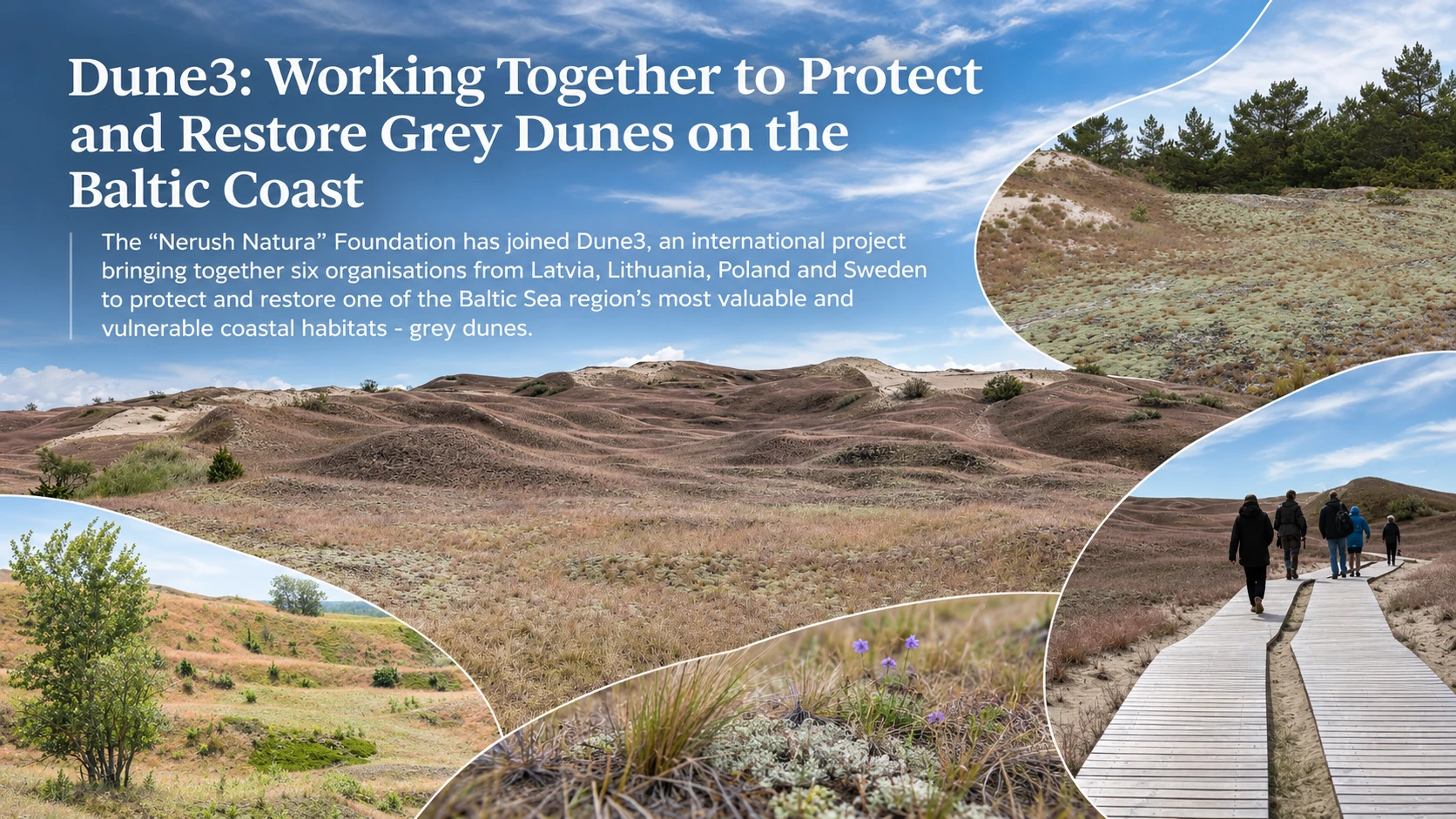
The “Nerush Natura” Foundation has joined Dune3, an international project bringing together six organisations from Latvia, Lithuania, Poland and Sweden to protect and restore one of the Baltic Sea region’s most valuable and vulnerable coastal habitats – grey dunes.
The project, Collaborative Planning and Pilot Actions for Grey Dunes Restoration in the South-East Baltic, is implemented under the Interreg Baltic Sea Region 2021–2027 Programme from 1 July 2026 to 30 June 2028.
Why do grey dunes need protection?
Grey dunes are unique coastal ecosystems characterised by sparse vegetation, dry sandy soils and specialised plant and animal communities. They are recognised as a priority habitat for conservation under the EU Habitats Directive (habitat type 2130* – Fixed coastal dunes with herbaceous vegetation).
Despite their ecological importance, grey dunes along the south-eastern Baltic coast face increasing threats. Coastal erosion, climate change, expanding tourism, recreational pressure and other human activities are contributing to habitat degradation and biodiversity loss.
Protecting these fragile ecosystems requires more than isolated conservation measures. It calls for coordinated action across national borders, practical restoration solutions and the active involvement of local communities.
Dune3: A joint approach to coastal conservation
Dune3 aims to strengthen the protection and restoration of grey dunes in Latvia, Lithuania and Poland through international cooperation, knowledge exchange and practical conservation activities.
The project brings together regional planning institutions, environmental NGOs and coastal conservation experts to develop a shared approach to managing and restoring these valuable habitats.
A key outcome will be the Joint Baltic Grey Dune Restoration Plan, supported by national annexes for Latvia, Lithuania and Poland. The Plan will provide practical recommendations for habitat restoration, biodiversity conservation and sustainable coastal management.
To ensure that recommendations are based on real-world experience, pilot restoration activities will be carried out in Latvia and Lithuania. These activities will test restoration methods, assess their effectiveness and generate lessons for future conservation efforts across the Baltic Sea region.
Engaging communities and promoting citizen science
An important part of Dune3 is raising public awareness and encouraging people to participate in coastal conservation.
The project will develop educational and communication materials, including a documentary film, podcasts and information resources highlighting the ecological importance of grey dunes and the challenges they face.
Special attention will be given to citizen science and community engagement. Local residents, volunteers, environmental organisations and coastal visitors will have opportunities to learn about grey dune ecosystems and contribute to their monitoring and protection.
By connecting scientific knowledge with community participation, Dune3 seeks to make coastal conservation more accessible, inclusive and effective.
The project will also promote responsible tourism, demonstrating how the Baltic coastline can remain an attractive destination for recreation while preserving its unique natural heritage.
The role of the “Nerush Natura” Foundation
As the Polish project partner, the “Nerush Natura” Foundation will contribute its experience in environmental education, biodiversity conservation, citizen science, public engagement and international environmental cooperation.
The Foundation will participate in the development of joint approaches to grey dune protection and restoration, facilitate knowledge exchange and cooperation with Polish stakeholders, and support communication and awareness-raising activities.
Particular attention will be given to involving environmental organisations, protected area managers, experts and local communities in discussions on sustainable coastal management.
Through Dune3, the Foundation aims to strengthen cooperation between environmental stakeholders in Poland and other Baltic Sea countries, promote evidence-based conservation practices and encourage greater public responsibility for protecting fragile coastal ecosystems.
Six partners, four countries, one shared goal
The Dune3 partnership consists of six organisations:
Kurzeme Planning Region, Latvia – Lead Partner;
Latvian Green Movement, Latvia;
EUCC Baltic Office, Lithuania;
Lithuanian Fund for Nature, Lithuania;
“Nerush Natura” Foundation, Poland;
Coalition Clean Baltic, Sweden.
Together, the partners combine expertise in coastal planning, nature conservation, ecological restoration, environmental communication and transnational cooperation.
Towards a more resilient Baltic coast
Dune3 is more than a habitat restoration project. It is an opportunity to build lasting cooperation between countries, institutions and communities that share responsibility for the future of the Baltic Sea coastline.
By combining practical restoration, joint planning, scientific expertise and public participation, the project will contribute to biodiversity conservation, climate resilience and the sustainable use of coastal resources.
Protecting grey dunes means protecting the biodiversity, natural landscapes and ecological resilience of the Baltic coast for future generations.
Project information
Full title: Collaborative Planning and Pilot Actions for Grey Dunes Restoration in the South-East Baltic
Acronym: Dune3
Project number: S048
Programme: Interreg Baltic Sea Region 2021–2027
Priority: 2. Water-smart societies
Programme objective: 2.2 Blue economy
Project type: Small Project
Implementation period: 1 July 2026 – 30 June 2028
Project countries: Latvia, Lithuania, Poland and Sweden
The Dune3 project is implemented within the Interreg Baltic Sea Region 2021–2027 Programme, co-funded by the European Union.
Together for Nature and People!